
Marcher Miscellany
An online half-day conference
Date
Online Conference – Saturday 31st January 2026, 2.00pm to 4.45pm (join from 1.45pm)
Venue
Online Only
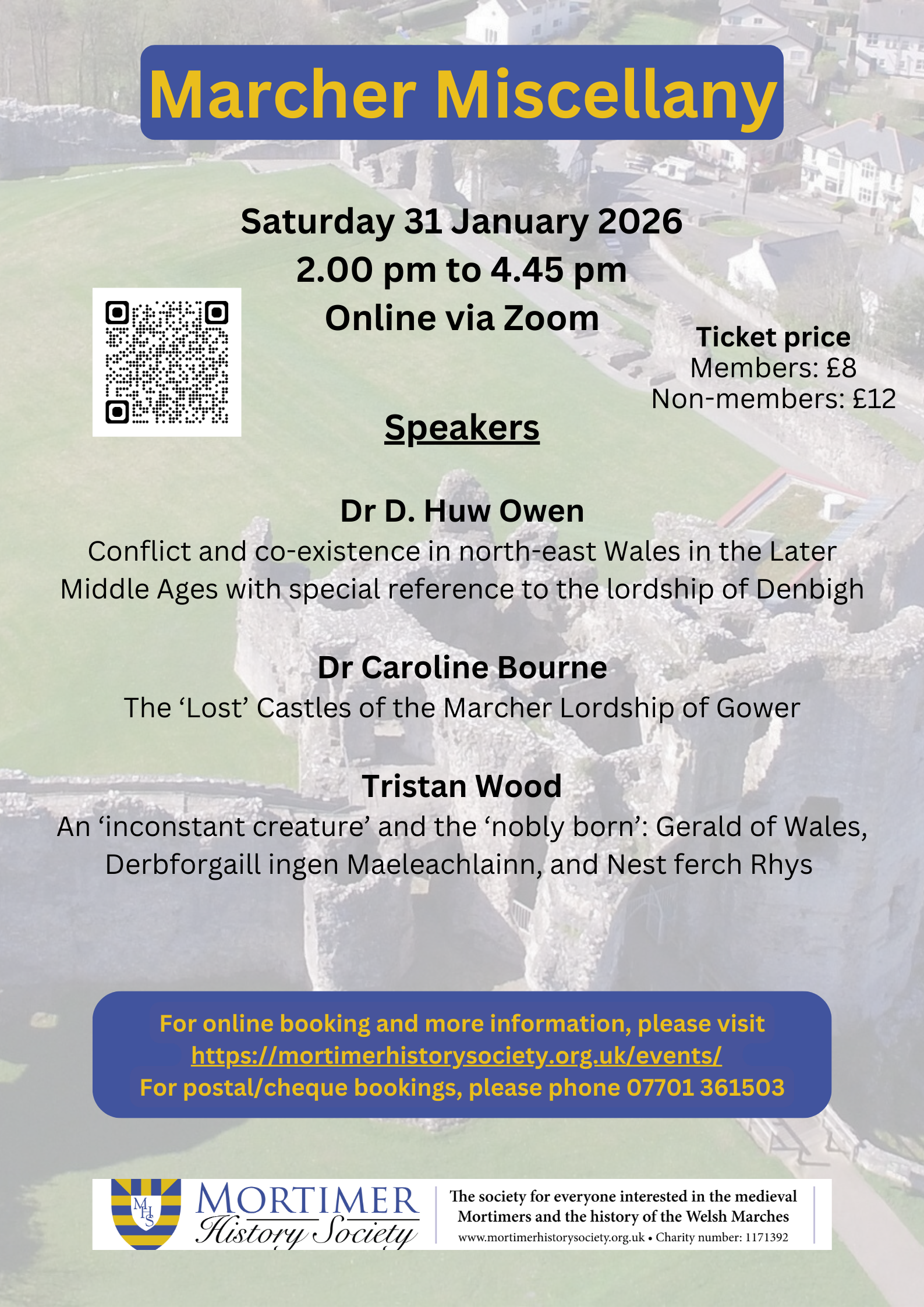
Programme, Synopses and Biographies
Programme – Saturday 31st January 2026, 2.00pm to 4.45pm
13.45 Participants to start to join the conference on Zoom (without video and audio)
14.00 Welcome and Introductions.
14.05 Dr D. Huw Owen
Conflict and co-existence in north-east Wales in the Later Middle Ages with special reference to the lordship of Denbigh.
14.45 Questions to Dr D. Huw Owen
14.55 Dr Caroline Bourne
The ‘Lost’ Castles of the Marcher Lordship of Gower
15.35 Break
15.50 Questions to Dr Caroline Bourne
15.55 Tristan Wood
An ‘inconstant creature’ and the ‘nobly born’: Gerald of Wales, Derbforgaill ingen Maeleachlainn, and Nest ferch Rhys.
16.35
Questions to Tristan Wood and the other speakers
16.45 Close
Tickets
This is an online event only
Saturday 31st January only: members £8.00; non-members £12.00
Online Booking

By telephone
0333 666 3366
(£2 booking fee)
TicketSource problems
If you have problems using TicketSource website, please use the phone number above to discuss issues with TicketSource. If your booking cannot be resolved by this method, please contact Pamela Thom-Rowe on 07701 361503.

Dr D. Huw Owen – Conflict and co-existence in north-east Wales in the Later Middle Ages with special reference to the Lordship of Denbigh
Analysis of the information provided on significant tenurial trends in the lordship of Denbigh by a series of surveys, rentals and financial accounts in the fourteenth, fifteenth and early sixteenth centuries. Discussion would also refer to the evidence relating to the displacement of families in the lordship following the introduction of numerous settler families, the subsequent success of local individuals in acquiring available properties, and the emergence in this locality of gentry families and a flourishing Welsh bardic tradition.
Dr D. Huw Owen served as archivist and administrator at Aberystwyth University; lecturer at the College of Librarianship Wales, Aberystwyth and at Cardiff University; and as Keeper of Pictures and Maps at the National Library of Wales, Aberystwyth. His publications include the volume The Lordship of Denbigh, 1282-1543 published in 2024 by the University of Wales Press.
.
Dr Caroline Bourne – The ‘Lost’ Castles of the Marcher Lordship of Gower
Discover the hidden history of the Marcher lordship of Gower in this talk, which explores the evidence for ‘lost’ castles that once shaped the region’s medieval landscape. Drawing on Dr Bourne’s research, we will journey through scarce early records and intriguing later clues that suggest some earth and timber castles have vanished from view. By piecing together documentary hints and interpreting the landscape, this talk reveals where these forgotten fortifications may have stood and how they helped establish Anglo-Norman rule in Gower. Join us for fresh insights into the area’s past and the fascinating relationship between the Anglo-Normans and the native Welsh.
Caroline Bourne completed her PhD at the University of Reading in 2024, where she challenged long-held beliefs about the Anglo-Norman conquest of Gower. Her research uncovers the complex and often subtle interactions between the newcomers and the Welsh, offering a richer understanding of the region’s history. Caroline’s expertise on Gower has been featured in Alex Harvey’s book, Little Kingdoms: An A-Z of Early Medieval Britain, and she has organised Mortimer History Society sponsored sessions at the International Medieval Congress 2026. She was a contributor to Medieval Perceptions of Magic, Science, and the Natural World, which was published in 2024, and she is currently a Visiting Research Fellow at the University of Reading researching the early development of regional identities.
Tristan Wood – An ‘inconstant creature’ and the ‘nobly born’: Gerald of Wales, Derbforgaill ingen Maeleachlainn, and Nest ferch Rhys
Gerald of Wales is perhaps one of the most prolific writers of the British Isles in the medieval period. As both a product and eyewitness of conquest, his works have become staples for academics researching Anglo- and Cambro-Norman experiences in Ireland and Wales. Whilst it is largely acknowledged that his elite status, ethnicity, and ecclesiastical background greatly influenced his writings concerning native Irish and Welsh people and women, there have been limited attempts to discuss them within a decolonial context. The subsequent historiographical depictions of women like Derbforgaill ingen Maeleachlainn and Nest ferch Rhys have largely become one-sided, particularly when discussing their agency. Thus, this talk intends to compare Gerald’s narratives with Irish and Welsh sources concerning Derbforgaill and Nest, particularly contemporary chronicles such as the Annals of Clonmacnoise and Brut y Tywysogyon. In doing so, it seeks to question how and why Gerald’s works legitimised colonial narratives surrounding Irish and Welsh women in contrast to those depicted within native literature. It will further explore the extent to which Gerald’s views were comparable to those shared by other contemporary colonial and Anglo-Norman sources such as The Deeds of the Normans in Ireland. As a result, this paper aims to present an exploration of Gerald’s narratives of Derbforgaill and Nest that reinforces the importance of analysing medieval works through a decolonial lens.
Tristan Wood is a second year PhD student at Aberystwyth University and one of the recipients of the Mortimer History Society Bursary for 2025. His research analyses elite Irish and Welsh women between 1100 and 1300, with a focus on the relationship between their agency and their identities. So far, his research has allowed him to engage with a variety of theoretical approaches to historical study such as decolonialism, as well as cover a vast range of primary sources, including those more traditionally covered by scholars from the field of Celtic studies. As a result, he intends for his research to provide a highly nuanced and interdisciplinary interpretation of elite medieval Irish and Welsh women’s experiences.