
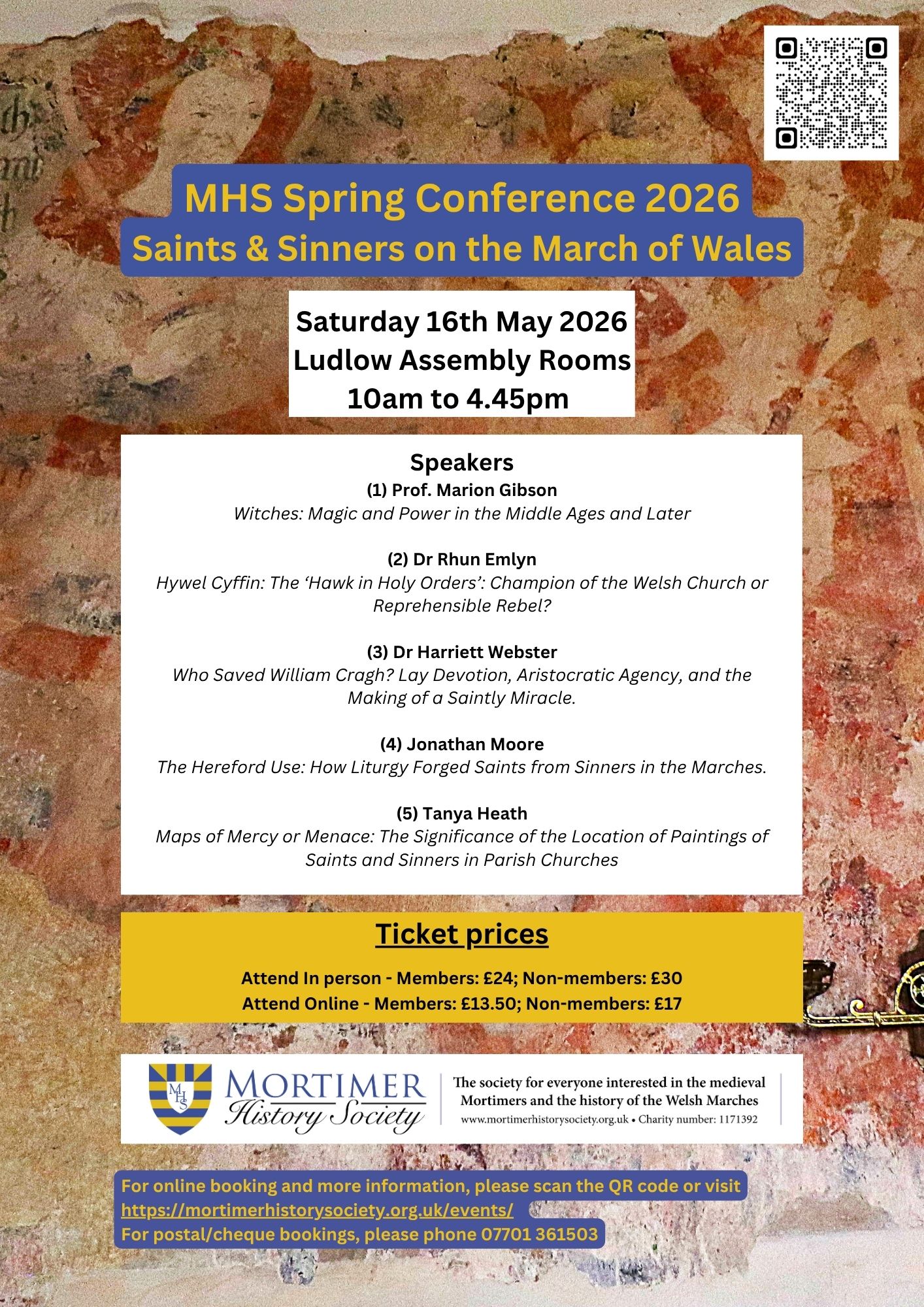
Spring Conference 2026
Saints & Sinners on the March of Wales
Date
Saturday 16th May 2026
10.00 to 16.45, Doors open 09.15
Venue
Ludlow Assembly Rooms
1 Mill Street, Ludlow SY8 1AZ
Parking
For full details follow this link to the Assembly Rooms website ☛☛
Programme, Synopses and Biographies
Tickets
Attend in Person
Society Members: £24.00
Non-Members: £30.00
Attend Remotely via Zoom
Society Members: £13.50
Non-Members: £17.00
Online Booking

By telephone
0333 666 3366
TicketSource problems
If you have problems using TicketSource website, please use the phone number above to discuss issues with TicketSource. If your booking cannot be resolved by this method, please contact Pamela Thom-Rowe on 07701 361503

© The Trustees of the British Museum Shared under a Creative Commons Attribution-NonCommercial-ShareAlike 4.0 International (CC BY-NC-SA 4.0) licence.
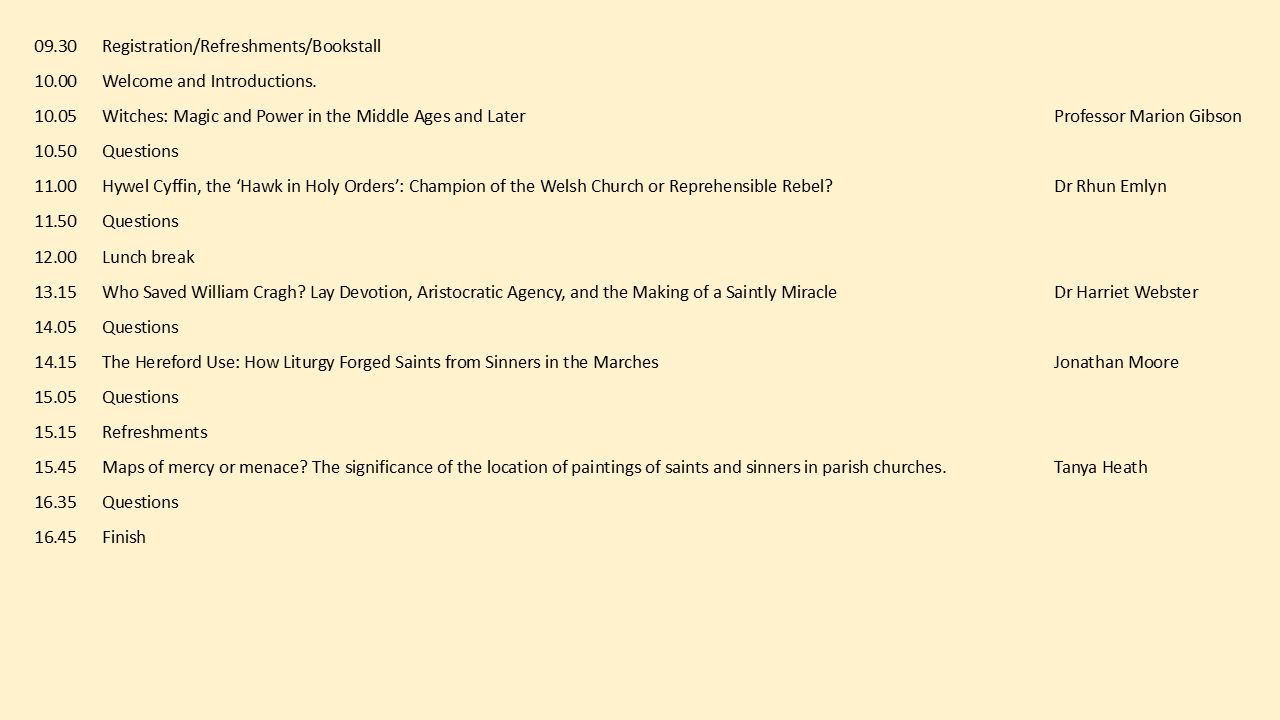
Professor Marion Gibson – Witches: Magic and Power in the Middle Ages and Later
This talk will explore a Medieval English witch trial and compare it with a seventeenth-century one that took place in Ludlow to trace patterns in witch trials over time.
Professor Marion Gibson has been fascinated by witch trial records for thirty years and is the author of Witchcraft: A History in 13 Trials (Simon and Schuster, 2023), The Witches of St Osyth (Cambridge University Press, 2022) and many other books on witches, magic and mysticism in history.
Dr Rhun Emlyn – Hywel Cyffin, the ‘Hawk in Holy Orders’: Champion of the Welsh Church or Reprehensible Rebel?
This talk will explore the life of the Marcher cleric Hywel Cyffin, the topic of the winning entry in the 2024 Mortimer History Society Essay Prize. Hywel Cyffin was a man of status and wealth in the Marches as well as a successful and respected cleric. He was a larger-than-life-figure: a combative character who defended the rights and traditions of his fellow Welsh higher clergy while blatantly challenging the Church’s moral expectations and being one of the instigators of the Glyndŵr Rebellion. Examining his life and placing him within his context enables us to explore the nature of Marcher society, political tensions within the Welsh Church and why clergy were instrumental in rebellions. This will allow us to question whether Hywel should be considered a ‘saint’, a ‘sinner’ or both.
Dr Rhun Emlyn (BA, MA, PhD) is a lecturer in medieval and Welsh history at Aberystwyth University. He has specialised in the careers of medieval Welsh students and clergy and is currently exploring the involvement and role of clergy in the Glyndŵr Rebellion.
Dr Harriet Webster – Who Saved William Cragh? Lay Devotion, Aristocratic Agency, and the Making of a Saintly Miracle
This paper revisits the dramatic resurrection of the condemned Welsh brigand William Cragh to ask a deceptively simple question: who really saved him? While Cragh’s own appeal to St Thomas Cantilupe appears central, this study foregrounds the decisive role of Mary de Briouze, whose prayers, ritual actions, and patronage shaped both the miracle itself and its subsequent promotion. Set within the fraught landscape of the Welsh Marches, the paper explores how sanctity was negotiated between sinner and saint and argues that aristocratic lay devotion – especially that of elite women – was crucial in transforming criminal bodies into vehicles of divine power.
Dr Harriet Webster is currently Senior Lecturer in Medieval History at UWTSD, but knows the Marches well, having grown up in Ludlow. Before this appointment, I was the research assistant on the AHRC-funded ‘City Witness: Place and Perspective in Medieval Swansea’ project, where I first met the ‘sinner’ William Cragh (though I knew St Thomas Cantilupe well as I based one of me GCSE Art pieces on his tomb in Hereford Cathedral). My follow up research on Cantilupe’s canonisation process, How to Make a Saint in Six Easy Steps, is under contract with the University of Wales Press.
Jonathan Moore – The Hereford Use: How Liturgy Forged Saints from Sinners in the Marches
This talk examines the Hereford Use (c. 1150–1549), the distinctive medieval liturgy of Herefordshire, and its power to shape the moral and spiritual life of the people in the Marches. It explores the structure, music, and prayers of the rite within the cathedral, whose architecture, altars, and adornments provided both the stage and framework for devotion. Through this carefully ordered liturgy, the congregants were guided on a journey toward God, in which even the lowliest sinner could be drawn into holiness. The Hereford Use emerges not as an outworking of medieval superstition but as a system of spiritual formation. It shaped both belief and practice across the medieval Marches, making of its people saints from sinners.
Jonathan Moore was brought up in Herefordshire and is currently a PhD student at the University of St Andrews (Scotland), where he studies Hugh of St Victor, a twelfth-century theologian and mystic in Paris. His research focuses on medieval theology and medieval church history, the theology of wisdom, and the role of liturgy and the sacraments in shaping the spiritual life.
Tanya Heath – The English Church is to be free: Magna Carta, the Church, and the Crown
Medieval images of saints are found on the walls of many parish churches, alongside the images of sin used to guide parishioners’ behaviours. Understanding the topography of the images around the walls can explain why each painting was chosen and the purpose it was intended to fulfil, telling us whether a picture was supposed to inspire thoughts of fear, penitence, devotion or the hope of mercy. This illuminates the personal and social significances of the saints and sinners depicted, marking the triumphs and disasters of each medieval life.
Tanya Heath is a final year doctoral candidate at Oriel College, University of Oxford. Her research focuses on the performance of confession and penance in the late medieval church, using medieval wall-paintings to help illuminate its spaces and rituals. Tanya holds a MSt in Medieval History from Kellogg College, Oxford, which also specialised in medieval religious art. As a mature student, she also holds an MBA and works as an auditor.