
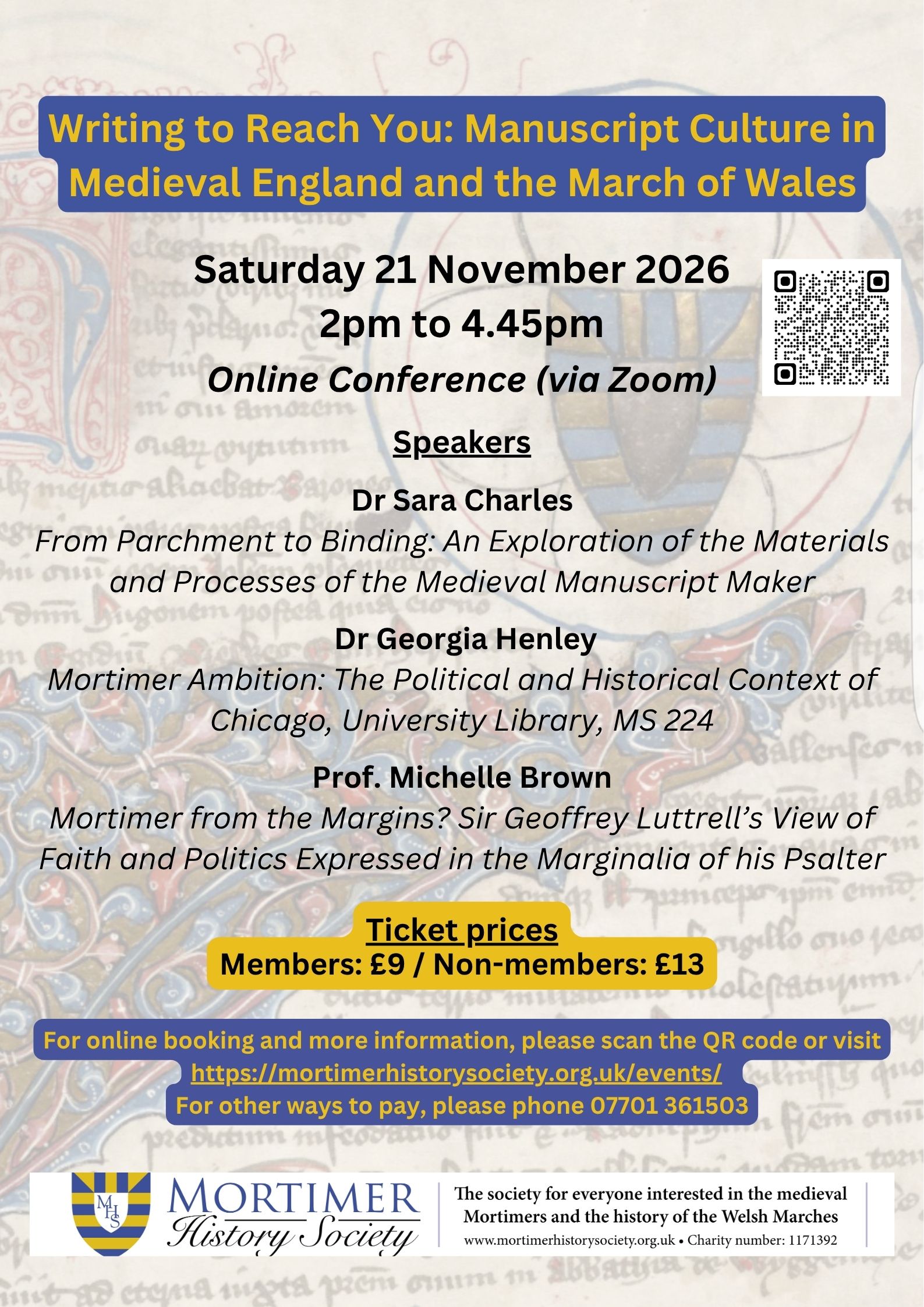
Writing to Reach You: Manuscript Culture in Medieval England and the March of Wales
An online half-day conference
Date
Online Conference – Saturday 21st November 2026, 2.00pm to 4.45pm (join from 1.45pm)
Venue
Online Only
Programme, Synopses and Biographies
Programme – Saturday 21st November 2026, 2.00pm to 4.45pm
13.45 Participants to start to join the conference on Zoom (without video and audio)
14.00 Welcome and Introductions.
14.05 Dr Sara Charles
From Parchment to Binding: An Exploration of the Materials and Processes of the Medieval Manuscript Maker
14.45 Questions to Dr Sara Charles
14.55 Dr Georgia Henley
Mortimer Ambition: The Political and Historical Context of Chicago, University Library, MS 224
15.35 Break
15.50 Questions to Dr Georgia Henley
15.55 Prof. Michelle Brown
Mortimer from the Margins? Sir Geoffrey Luttrell’s View of Faith and Politics Expressed in the Marginalia of his Psalter
16.35
Questions to Prof. Michelle Brown and the other speakers
16.45 Close
Tickets
This is an online event only
Saturday 21st November 2026 only: members £9.00; non-members £13.00
Online Booking

By telephone
0333 666 3366
TicketSource problems
If you have problems using TicketSource website, please use the phone number above to discuss issues with TicketSource. If your booking cannot be resolved by this method, please contact Pamela Thom-Rowe on 07701 361503.

Dr Sara Charles – From Parchment to Binding: An Exploration of the Materials and Processes of the Medieval Manuscript Maker
Every medieval manuscript is a single unique object, largely sourced from natural products and produced completely by human hands. The making process was often dirty, smelly, often boring and certainly back breaking. This talk will look at the materials and processes of medieval manuscripts, focusing on the making of parchment, ink, quills, illumination, pigments and bookbinding. Using examples from medieval recipes, the processes of manuscript making will be explored, discussing the range of materials that could either be grown locally, manufactured or traded from overseas and how they all came together to form a book. With demonstration videos this talk will open a window into the life of a medieval scribe.
Dr Sara Charles is a practitioner exploring the materials of medieval manuscripts, recreating manuscript production techniques to understand the practices of the past. By experiencing the smells, textures and sounds that medieval manuscript makers would have encountered, she can appreciate problems or difficulties that they would have faced in their everyday working lives. She has a doctorate in medieval martyrologies and works at the Institute of Historical Research, London. She has published on different aspects of book history, including The Medieval Scriptorium.
Dr Georgia Henley – Mortimer Ambition: The Political and Historical Context of Chicago, University Library, MS 224
This talk considers the creation and provenance of Chicago, University Library, MS 224, a fourteenth-century compilation of historical and genealogical texts probably written at Wigmore Abbey for the Mortimer family. Collectively, the texts in the manuscript present an argument for Roger Mortimer, 4th earl of March’s legitimacy as the successor to King Richard II, an argument made possible by access to historical sources from Wales. The compilation places particular emphasis on the earls of March as the heirs to Geoffrey of Monmouth’s kings of Britain, revealed in an analysis of the manuscript’s contents as a coherent whole. The talk concludes by discussing future directions for the study of this important manuscript.
Dr Georgia Henley is an associate professor of English at Saint Anselm College in New Hampshire, USA, and an associate of the Department of Celtic Languages and Literatures at Harvard University. Her first book, Reimagining the Past in the Borderlands of Medieval England and Wales was published by Oxford University Press in the Textual Perspectives series in 2024.
Prof. Michelle Brown FSA – Mortimer from the Margins? Sir Geoffrey Luttrell’s View of Faith and Politics Expressed in the Marginalia of his Psalter
The Luttrell Psalter offers a remarkably frank, if visually coded, view of the age in which it was made (1330s-1340s). It contains one of the most highly personalised iconographic schemes to be found, probably devised by Sir Geoffrey’s confessor and chaplain, the Dominican Brother William of Fotheringay. His patron’s agendas and concerns in this world and the next are incorporated into its extraordinary marginal scenes. The old soldier and wool baron was fiercely loyal to the late King Edward I and his reactions to the new regime and attempts to help effect regime change will be explored in this illustrated talk. The Luttrells were a colourful lot in a colourful age!
Prof. Michelle Brown FSA is Professor Emerita of Medieval Manuscript Studies, SAS, University of London; formerly Curator of Illuminated Manuscripts, British Library.