
Autumn Conference 2026
The Bayeux Tapestry: the story of a Conquest
Date
Saturday 10th October 2026
10.00 to 16.45, Doors open 09.15
Venue
Ludlow Assembly Rooms
1 Mill Street, Ludlow SY8 1AZ
Parking
For full details follow this link to the Assembly Rooms website ☛☛
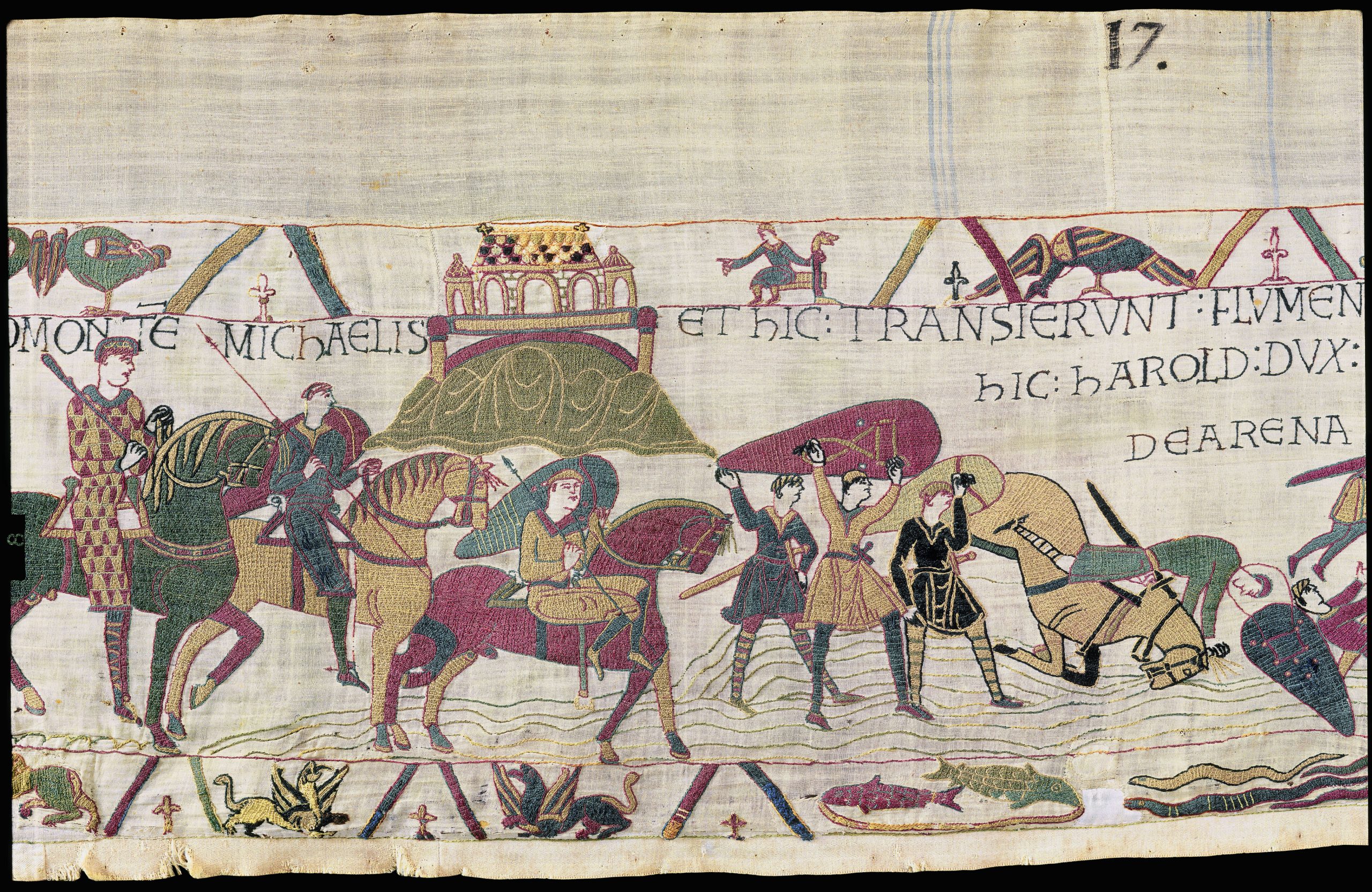
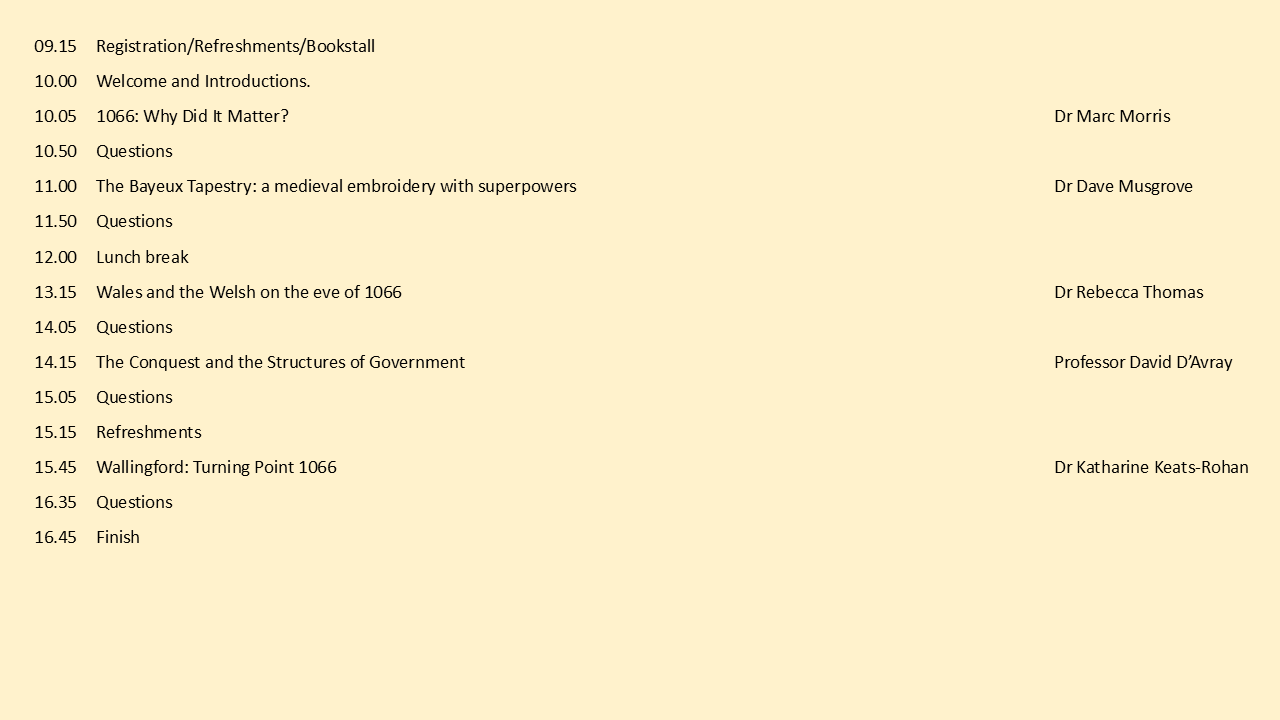
Programme, Synopses and Biographies
Tickets
Attend in Person
Society Members: £24.00
Non-Members: £30.00
Attend Remotely via Zoom
Society Members: £13.50
Non-Members: £17.00
Online Booking

By telephone
0333 666 3366
TicketSource problems
If you have problems using TicketSource website, please use the phone number above to discuss issues with TicketSource. If your booking cannot be resolved by this method, please contact Pamela Thom-Rowe on 07701 361503

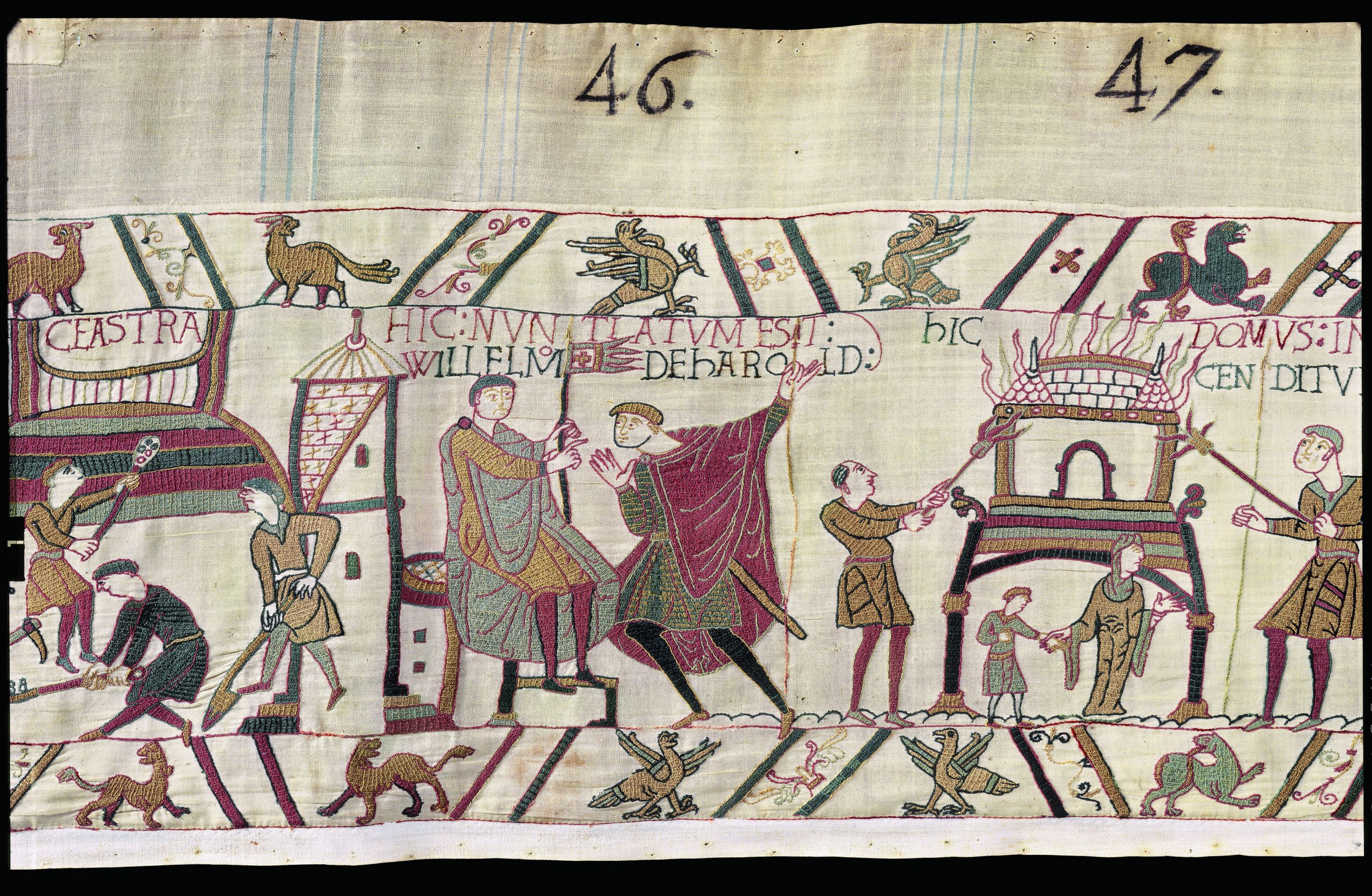
© The Trustees of the British Museum Shared under a Creative Commons Attribution-NonCommercial-ShareAlike 4.0 International (CC BY-NC-SA 4.0) licence.
Dr Marc Morris – 1066: Why Did It Matter?
1066 is the most famous date in English history. Everyone remembers the story, depicted on the Bayeux Tapestry, of William the Conqueror’s successful invasion, and the unfortunate King Harold being felled by an arrow in the eye. But why do we remember 1066 above all other dates, and why do the events of that year matter so much?
Dr Marc Morris is a historian who specialises in the Middle Ages. He studied and taught at the universities of London and Oxford and is a fellow of the Royal Historical Society. He is the author of the Sunday Times bestseller The Anglo-Saxons: A History of the Beginnings of England (2021). His other books include King John: Treachery, Tyranny and the Road to Magna Carta (2015), The Norman Conquest (2012) and A Great and Terrible King: Edward I and the Forging of Britain (2008).
Dr Dave Musgrove – The Bayeux Tapestry: a medieval embroidery with superpowers
With the opening in September 2026 of the Tapestry at The British Museum, Dave will consider how the Bayeux Tapestry has shaped our knowledge of the Norman Conquest and continues to exert its influence to this day.
Dr Dave Musgrove is content director of HistoryExtra Magazine and podcast, and author, with Prof Michael Lewis, of The Story of the Bayeux Tapestry.
Dr Rebecca Thomas – Wales and the Welsh on the eve of 1066
This talk will approach the Norman Conquest of England from a Welsh perspective. It will consider the political makeup of Wales on the eve of 1066, focusing especially on Anglo-Welsh relations during the reign of King Gruffudd ap Llywelyn (d. 1063) and in the aftermath of his death. This will feed into a consideration of how subsequent Norman kings approached Wales. Finally, the talk will consider Welsh responses to the Norman conquest of England. How significant was 1066 for the Welsh? The evidence of vernacular and Latin chronicles will be drawn upon to answer this question.
.
Dr Rebecca Thomas is a Senior Lecturer in Medieval History at Cardiff University. She has published widely on aspects of the history, language and literature of medieval Wales, including her monograph, History and Identity in Early Medieval Wales (Cambridge: D.S. Brewer, 2022), which was awarded the Francis Jones Priize for Welsh History in 2023. She is also a Welsh-language novelist and author of the dystopian campus novel Y Tŵr (Sebra, 2025).
Professor David D’Avray – The Conquest and the Structures of Government
The Bayeux Tapestry is the most vivid representation of one of the most dramatic and rapid transformations in English history, but the long-term structural effects of the conquest are less obvious and perhaps even more important: a governmental system perhaps unique in world history and even the eventual and lasting structure of the constitution.
Professor David D’Avray, Lecturer, Reader, Professor, and Emeritus Professor of History, University College London. Supernumerary Fellow and Dean of Degrees, Jesus College Oxford. Has published (13 monographs) on medieval preaching as mass communication, and as evidence for attitudes to monarchy, death, and marriage; the practical influence of symbolism on the social and legal history of medieval marriage was the next theme; after that, different kinds of rationality in history, both comparatively and with reference to the Middle Ages; the most recent published research has been on the royal marriages and papal law. Current research aims to apply sociological concepts to understanding papal Christianity between Antiquity and the Enlightenment.
Dr Katharine Keats-Rohan – Wallingford: Turning Point 1066
The title of this talk is the title of Wallingford’s official contribution to Millenium, the 2027 Year of the Normans. It focuses on the evidence of chronicler William of Poitiers, and his account of how the Normans crossed the Thames at Wallingford, receiving the submission of Archbishop Stigand. This episode was of pivotal importance for English history, as well as that of Wallingford and deserves closer attention than it has had to date, since it paved the way for the final surrender of the child king-elect Edgar and the two surviving earls at Berkhamsted and thence the coronation of William at Westminster. It will draw upon, inter alia, both Domesday Book and the Bayeux Tapestry, as well as extensive archaeological and historical work in Wallingford in the past 15 years.
Dr Katharine Keats-Rohan, FSA, FRHistS, Katharine Keats-Rohan has had a long academic career as a medieval historian, covering NW France, the Norman Conquest, Mont St Michel and, as member of The Wallingford Historical & Archaeological Society (TWHAS) and Wallingford Museum, medieval Wallingford. Publications include Domesday People (1999), The Cartulary of Mont St Michel (2006), Prosopography Approaches and Applications (2007), and Wallingford the Castle and the Town in Context (2015). Katharine is a public contributor to health research, where she advocates for family carers. She has served as a Wallingford Town Councillor since 2019, and also as District Councillor since 2023, and represents the towns and parishes of Oxfordshire on the National Association of Local Council’s National Assembly.