
Marcher Miscellany
An online half-day conference
Date
Online Conference – Saturday 30th January 2027
2.00pm to 4.45pm (join from 1.45pm)
Venue
Online Only
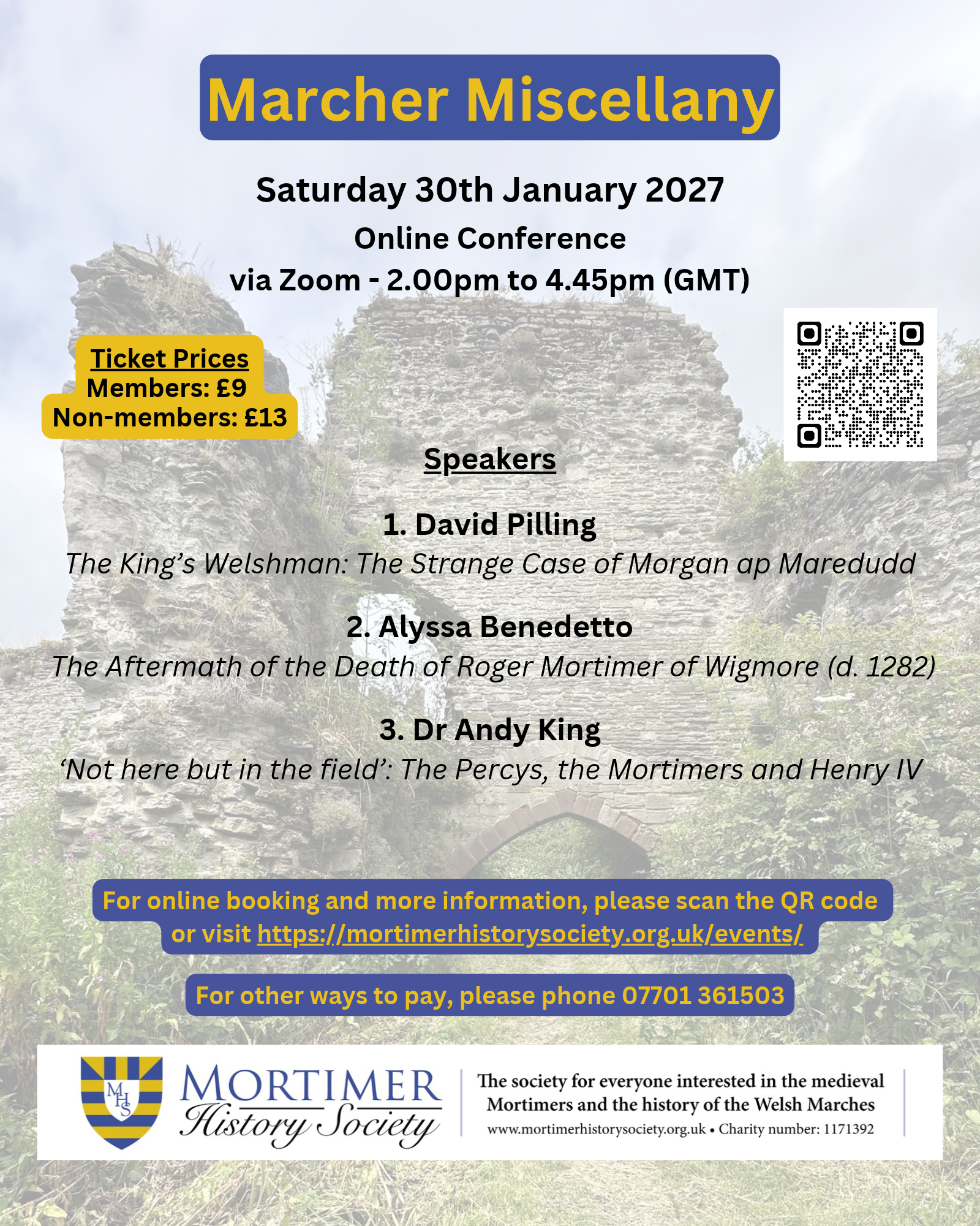
Programme, Synopses and Biographies
Programme – Saturday 30th January 2027, 2.00pm to 4.45pm
13.45 Participants to start to join the conference on Zoom (without video and audio)
14.00 Welcome and Introductions
14.05 David Pilling
The King’s Welshman: the Strange Case of Morgan ap Maredudd
14.45 Questions to David Pilling
14.55 Alyssa Benedetto
The Aftermath of the Death of Roger Mortimer of Wigmore (d. 1282)
15.35 Break
15.50 Questions to Alyssa Benedetto
15.55 Dr Andy King
‘Not here but in the field’: The Percys, the Mortimers and Henry IV
16.35 Questions to Dr Andy King and the other speakers
16.45 Close
Tickets
This is an online event only
Saturday 30th January only: members £9.00;
non-members £13.00
Online Booking

By telephone
0333 666 3366
TicketSource problems
If you have problems using TicketSource website, please use the phone number above to discuss issues with TicketSource. If your booking cannot be resolved by this method, please contact Pamela Thom-Rowe on 07701 361503.

David Pilling – The King’s Welshman: the Strange Case of Morgan ap Maredudd.
In 1294, Morgan ap Maredudd led a devastating Welsh revolt against Gilbert de Clare, Earl of Gloucester and one of the most powerful Marcher lords. Yet, instead of suffering the fate of a defeated rebel, Morgan was pardoned by Edward I and went on to become one of the king’s trusted agents.
Descended from the ancient rulers of Morgannwg, Morgan had been deprived of his inheritance and spent years unsuccessfully seeking redress through the courts. His subsequent career took him from rebellion and political intrigue to secret royal missions, military command and knighthood.
Drawing on contemporary chronicles and surviving administrative and legal records, this talk examines Morgan’s transformation from dispossessed Welsh nobleman to royal servant. It also explores a more provocative possibility: that his rebellion against the Earl of Gloucester was not directed against the English Crown at all but formed part of a wider struggle for power between Edward I and his Marcher lords.
David Pilling is a writer and historical researcher with a particular passion for medieval history, inspired by a childhood spent exploring Welsh castle ruins. His interests also include the Byzantine Empire, post-Roman Britain and medieval outlaw traditions. He writes both historical fiction and non-fiction, with published works including Outlaw Knight, Leader of Battles, Reiver, and The Bloody Hand Saga. He is currently completing a series on Philip of Cognac, Richard I’s illegitimate son. His non-fiction work focuses on Edward I’s military campaigns, the Empire of Nicaea and the Montfortian Wars.
Alyssa Benedetto – The Aftermath of the Death of Roger Mortimer of Wigmore (d. 1282).
On 27 October 1282, Roger Mortimer was lain to rest before the high altar in Wigmore Abbey. Inscribed on his tomb were the words, ‘Here lies buried, glittering with praise, Roger the pure, Roger Mortimer the second, called Lord of Wigmore by those who held him dear. While he lived all Wales feared his power, and given as a gift to him all Wales remained his. It knew his campaigns, he subjected it to torment’.
Acknowledging the emphasis within this late thirteenth-century epitaph, this paper will consider the aftermath of the death of Roger Mortimer where his relationships to people, power, and politics are concerned. Correspondence and selected membranes from the Calendars of Welsh Rolls and Ancient Correspondence in Wales will allow for further exploration of Roger’s relationships to his family, associates, subjects, and the king. Analysing these relationships, this paper weighs the loss and memory of the beloved and feared military captain against the events and activities that followed his death.
Alyssa Benedetto is a final year PhD student at the Universities of Strathclyde and Aberdeen. Following the completion of her Master of Research degree in Creative Writing at the University of Strathclyde, Alyssa’s interdisciplinary doctoral project in Creative Writing and Medieval History explores the roles of 13th century English Marcher noblewomen through the recorded activities and agency of Maud de Braose (1224-1301). Consulting the letters, chronicles, petitions, court rolls, and Calendars of Ancient Correspondence in Wales, she intends to reinforce the political, military, and religious activities of these noblewomen on the March of Wales through critical research and the narrativization of the life of Maud de Braose (1224-1301), Baroness Mortimer of Wigmore.
Dr Andy King – Not here but in the field’: The Percys, the Mortimers and Henry IV.
In 1399, the exiled Henry Bolingbroke came back to England, and overthrew the government of Richard II. In this, he had the backing of Henry Percy, earl of Northumberland, and his like-named son, better known to history as Hotspur. Bolingbroke had himself crowned as Henry IV; however, the young Edmund Mortimer, earl of March, had a claim to the crown which was arguably superior to that of Bolingbroke – and Hotspur was married to Elizabeth Mortimer, Edmund’s aunt. By 1403, relations between Henry IV and the Percy family had deteriorated to the point that Hotspur led an army against him, and came close to defeating him at the battle of Shrewsbury.
The talk will examine the extent to which the breakdown in relations between Henry IV and the Percies was due to Henry’s usurpation of the kingship; and in particular, whether in 1399, Bolingbroke swore an oath that he would not take the crown. Did Bolingbroke mislead the Percies in 1399? And to what extent was Hotspur’s rebellion in 1403 genuinely motivated by support for the Mortimer claim to the throne?
Dr Andy King is a Lecturer in History at the University of Southampton. His interests include Anglo-Scottish relations in the late Middle Ages; concepts of treason and rebellion; chivalry and the conduct of late medieval warfare; chronicles and historical writing; and castles. He has published numerous articles and wrote Edward I: A New King Arthur? for the Penguin Monarchs series, as well as co-editing, with Rémy Ambühl, a recent festschrift: Documenting Warfare: Records of the Hundred Years War, Edited and Translated in Honour of Anne Curry.